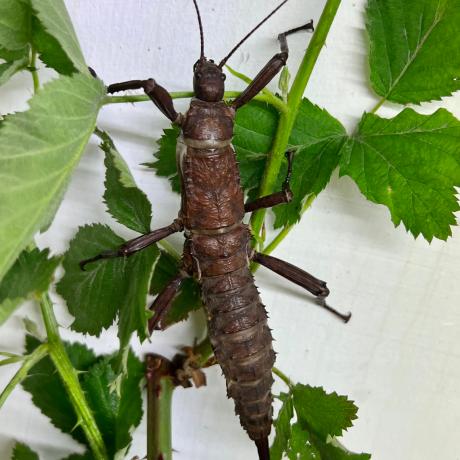
A large species of stick insect with some unusual characteristics; also known as the New Guinea Giant Spiny Stick Insect.
| Origin | Papua New Guinea |
|---|---|
| Environment | Rainforest |
| Adult Size | Up to 15cm |
| Suitability | Novice keeper |
| Lifespan | Up to 2 years |
| Food Type | Cherry, Beech, Hawthorn, Bramble, Rose, Oak, Hazel |
We personally think this species of stick insect looks a bit scary. Males have a large spike on the rear legs, when threatened, they hold up their abdomen and legs. The legs are quickly closed to trap/injury predators or fingers - this can be painful! Females have a large ovipositor for laying eggs into moist soil.
Nymphs look totally different compared to adults; they are generally mottled green and brown and seem to have smaller spikes along the body. As they mature, they become a dark brown to black and seem shiny; no wings are present. Adult females measure 12.5-15cm (5-6”) and weigh 20g, males are smaller at 10.5-12cm (4-5”).
They are found in trees and shrubs in the rain forest of the Papua New Guinea. During the day, they are found hiding/sleeping beneath bark and leaf matter. They are active at night and will come out to feed.
Most species of stick insects are easy to keep and the New Guineas Spiny Stick Insects are no exception.
The use of a large plastic tank or even a glass terrarium would be ideal for one adult pair; nymphs can be placed in smaller enclosures while growing. Place a layer of soil on the bottom of the enclosure with a covering of leaf litter. This species requires hides; cork bark, stones or reptile hides can be used. A temperature of 20-25C (68-7F) should be provided with the use of a heat mat on one side of the enclosure. Humidity needs to be in the range of 70%, spraying lightly each day or placing a shallow dish of water over the heat mat can help maintain this.
Feeding the New Guinea Sticks is very easy, we have listed all the foods plants this species has been known to eat; bramble (blackberry), hawthorn, apple, pear, cherry, oak, beech, ivy, may, alder, hazel, elm, rowan, knotweed, sorrel, vine, and species of Cotoneaster, Rhododendron, Croton and Tradescantia.
Place the food stems in a glass jar with water, this will keep the food plant fresh. Change the food every 2-3 days or when eaten and lightly mist with water daily.
Please be aware... Stick Insects can occasionally lose limbs during transit or while handling but don’t worry! With each progressive moult they will regenerate the missing limb and it will not affect them long term. While we make every effort to carefully pack and send out perfect insects, we cannot be held responsible if this happens once they have left our care.